
Pendimethalin
| Specification | |
| Active Ingredient | 95% min. |
| Appearance | Orange-yellow crystals |
| Physical and chemical properties | |
| Chemical Name |
N-(1-ethylpropyl)-2,6-dinitro-3,4-xylidine |
| Empirical Formula |
C13H19N3O4 |
| Molecular Weight |
281.3 |
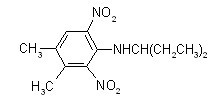
| Structural Formula |
|
| Melting point |
54-58℃ |
| Solubility |
In water 0.3 mg/l ( 20℃). In acetone 700, xylene 628, corn oil 148, heptane 138, isopropanol 77 (all in g/l, 26℃). Readily soluble in benzene, toluene, chloroform, and dichloromethane. Slightly soluble in petroleum ether and petrol. |
| Vapor pressure |
4.0 mPa (25℃) |
| Formulations |
|
97%TC, 40%EC, 330g/L EC
|
| Application |
|
Pendimethalin is a selective herbicide, absorbed by the roots and leaves. Affected plants die shortly after germination or following emergence from the soil. Used to control of most annual grasses and many annual broad-leaved weeds at 0.4-2.0 kg a.i./ha in cereals, onions, leeks, garlic, fennel, maize, sorghum, rice, soya beans, peanuts, brassicas, carrots, celery, black salsify, peas, field beans, lupins, evening primrose, tulips, potatoes, cotton, hops, pome fruit, stone fruit, berry fruit (including strawberries), citrus fruit, lettuce, aubergines, capsicums, established turf, and in transplanted tomatoes, sunflowers, and tobacco, applied pre-plant incorporated, pre-emergence, pre-transplanting, or early post-emergence. Also used for control of suckers in tobacco. |