
Propiconazole
| Specification | |
| Active Ingredient | 90% min. |
| Appearance |
Yellowish, odourless, viscous liquid (tech.). |
| Physical and chemical properties | |
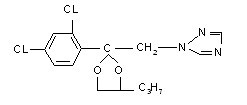
| Chemical Name | 1-[[2-(2,4-dichlorophenyl)-4-propyl-1,3-dioxolan-2-yl]=methyl]-1H-1,2,4-triazole |
| Empirical Formula | C15H12Cl2N3O2 |
| Molecular Weight |
342.2 |
| Structural Formula |
|
| Melting point | N/A |
| Solubility |
In water 100mg/l (20℃). In n-hexane 47 g/l. Completely miscible with ethanol, acetone, toluene and n-octanol ( 25℃). |
| Vapor pressure |
5.6×10⁻² mPa ( 20℃) |
| Formulations |
|
95%TC, 25%EC
|
| Application |
|
Systemic foliar fungicide with protective and curative action, with translocation acropetally in the xylem. Systemic foliar fungicide with a broad range of activity. On cereals, it controls diseases caused by Cochliobolus sativus, Erysiphe graminis, Leptosphaeria nodorum, Puccinia spp., Pyrenophora teres, Pyrenophora tritici-repentis, Rhynchosporium secalis, and Septoria spp. In banana, control of Mycosphaerella musicola and Mycosphaerella fijiensis var. difformis. Other uses are in turf against Sclerotinia homeocarpa, Rhizoctonia solani, Puccinia spp. and Erysiphe graminis; in rice against Rhizoctonia solani, Helminthosporium oryzae, and dirty panicle complex; in coffee against Hemileia vastatrix; in peanuts against Cercospora spp.; in stone fruit against Monilinia spp., Podosphaera spp., Sphaerotheca spp. and Traneschelia spp.; in maize against Helminthosporium spp. |