
Tebuconazole
| Specification | |
| Active Ingredient | 92% min. |
| Appearance |
Colourless crystals (tech., a colourless to light brown powder) |
| Physical and chemical properties | |
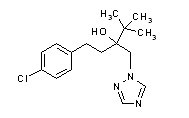
| Chemical Name | (±) -α-[2-(4-chlorophenyl)ethyl]] –α - (1,1- dimethylethyl)-=1H-1,2,4-triazole-1-ethanol |
| Empirical Formula |
C16H22ClN3O |
| Molecular Weight |
307.8 |
| Structural Formula |
|
| Melting point | 105℃ |
| Solubility |
In water 36 mg/l (pH5-9,20℃). In dichloromethane >200, isopropanol, toluene 50-100, hexane <0.1(all in g/l,20℃). |
| Vapor pressure |
1.7×10⁻³ mPa ( 20℃,OECD 104) |
| Formulations |
|
97%TC, 25%EC, 30%SC
|
| Application |
|
Tebuconazole is a systemic fungicide with protective, curative, and eradicant action. Rapidly absorbed into the vegetative parts of the plant, with translocation principally acropetally.
Used as a seed dressing, tebuconazole is effective against various smut and bunt diseases of cereals such as Tilletia spp., Ustilago spp., and Urocystis spp., also against Septoria nodorum (seed-borne), and Sphacelotheca reiliana in maize. As a spray, tebuconazole controls numerous pathogens in various crops: rust species (Puccinia spp.), powdery mildew (Erysiphe graminis), Rhynchosporium secalis, Septoria spp., Pyrenophora spp., Cochliobolus sativus and Fusarium spp. in cereals; Mycosphaerella spp., Puccinia spp. and sclerotium rolfsii in peanuts; Mycosphaerella spp. in bananas; Sclerotinia sclerotiorum and various pathogens of leaf and stem diseases in oilseed rape; Exobasidium vexans in tea; Phakopsora pachyrhizi in soya beans; Monilinia spp., rust species, powdery mildew and scab in pome and stone fruit; Botrytis spp., rust species, powdery mildew fungi, and (with dipping or spraying ) Sclerotium cepivorum in grapes and some vegetable crops.
|