
Gibberellic acid
| Specification | |
| Active Ingredient | 85% min. |
| Appearance |
Crystalline solid |
| Physical and chemical properties | |
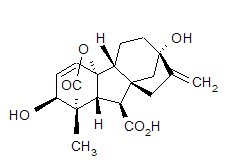
| Chemical Name | (1a,2ß,4aa,4bß,10ß)-2,4a,7-trihydroxy-1-methyl-8-=methylenegibb-3- -ene-1,10-dicarboxylic acid 1,4a-lactone |
| Empirical Formula | C19H22O6 |
| Molecular Weight | 346.4 |
| Structural Formula |
|
| Melting point | 223-225°C (decomp.) |
| Solubility |
In water 5 g/l (room temperature). Soluble in methanol, ethanol, acetone, and aqueous alkalis; slightly soluble in diethyl ether and ethyl acetate. Insoluble in chloroform. Potassium, sodium, and ammonium salts: Readily soluble in water (potassium salt 50 g/l ). |
| Vapor pressure |
|
| Formulations |
|
90%TC 20%SP 10%TB
|
| Application |
|
Acts as a plant growth regulator on account of its physiological and morphological effect in extremely low concentrations. Translocated. Generally affects only the plant parts above the soil surface. Gibberellic acid is a plant growth regulator, used in a variety of applications, e.g. to improve fruit setting of clementines and pears (especially William pears); to loosen and elongate clusters and increase berry size in grapes; to control fruit maturity by delaying development of the yellow colour in lemons; to reduce rind stain and retard rind ageing in navel oranges; to counteract the effects of cherry yellows virus diseases in sour cherries; to produce uniform seeding growth in rice; to promote elongation of winter celery crop; to induce uniform bolting and increase seed production in lettuce for seed; to break dormancy and stimulate sprouting in seed potatoes; to extend the picking season by hastening maturity in artichokes; to increase the yield in forced rhubarb; to increase the malting quality of barley; to produce brighter-colored, firmer fruit, and to increase the size of sweet cherries; to increase yields and aid harvesting of hops; to reduce internal browning and increase yields of ltalian prunes; to increase fruit set and yields of tangelos and tangerines; to improve fruit setting in blueberries; to advance flowering and increase the yield of strawberries; and also a variety of applications on ornamentals. |