
Paclobutrazol
| Specification | |
| Active Ingredient | 95% min. |
| Appearance |
White powder |
| Physical and chemical properties | |
| Chemical Name | (R*,R*)-(?--[(4-chlorophenyl)methyl]--(1,1-dimethylethyl)-1H-1,2,4-triazole-1-ethanol |
| Empirical Formula | C15H20ClN3O |
| Molecular Weight | 293.8 |
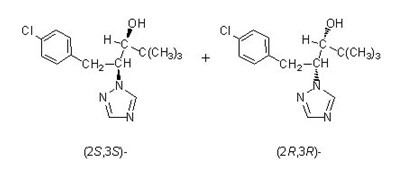
| Structural Formula |
|
| Melting point | 165-166℃ |
| Solubility |
In water 26 mg/l (20 ºC). In acetone 110, cyclohexanone 180, dichloromethane 100, hexane 10, xylene 60, methanol 150, propylene glycol 50 (all in g/l, 20 ºC). |
| Vapor pressure |
0.001 mPa (20℃) |
| Formulations |
|
95%TC,15% WP, 25%SC
|
| Application |
|
Plant growth regulator taken up into the xylem through the leaves, stems, or roots, and translocated to growing sub-apical meristems. Produces more compact plants and enhances flowering and fruiting. Used on fruit trees to inhibit vegetative growth and to improve fruit set; on pot-grown ornamentals and flower crops (e.g. chrysanthemums, begonias, freesias, poinsettias and bulbs) to inhibit growth; on rice to increase tillering, reduce lodging, and increase yield; on turf to retard growth; and on grass seed crops to reduce height and prevent lodging. To be applied as a foliar spray, as a soil rench, or by trunk injection. Has some fungicidal activity against mildew and rusts.
|