
Spinosad
| Specification | |
| Active Ingredient | 91% min. |
| Appearance |
Light grey to white crystals. |
| Physical and chemical properties | |
| Chemical Name |
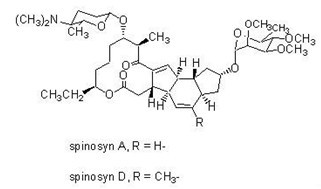
2-[(6-deoxy-2,3,4-tri-O-methyl--L-mannopyranosyl)oxy]-13-[[5-(dimethylamino)tetrahydro-6-methyl-2H-pyran-2-yl]oxy]-9-ethyl-2,3,3a,5a,5b,6,9,10,11,12,13,14,16a,16b-tetradecahydro-14-methyl-1H-as-indaceno(3,2-d)oxacyclododecin-7,15-dione (spinosyn A), mixture with 2-[(6-deoxy-2,3,4-tri-O-methyl--L-mannopyranosyl)oxy]-13-[[5-(dimethylamino)tetrahydro-6-methyl-2H-pyran-2-yl]oxy]-9-ethyl-2,3,3a,5a,5b,6,9,10,11,12,13,14,16a,16b-tetradecahydro-4,14-dimethyl-1H-as-indaceno(3,2-d)oxacyclododecin-7,15-dione (spinosyn D) |
| Empirical Formula |
C41H65NO10 (spinosyn A); C42H67NO10 (spinosyn D) |
| Molecular Weight |
732.0 (spinosyn A); 746.0 (spinosyn D) |
| Structural Formula |
|
| Melting point |
84-99.5 °C (spinosyn A); 161.5-170 °C (spinosyn D) |
| Solubility | Spinosyn A: In water 89 ppm (distilled water), 235 ppm (pH 7) (both 20 °C). In acetone 16.8, acetonitrile 13.4, dichloromethane 52.5, hexane 0.448, methanol 19.0, n-octanol 0.926, toluene 45.7 (all in g/l, 20 °C). Spinosyn D: In water 0.5 ppm (distilled water), 0.33 ppm (pH 7) (both 20 °C). In acetone 1.01, acetonitrile 0.255, chloromethane 44.8, hexane 0.743, methanol 0.252, n-octanol 0.127, toluene 15.2 (all in g/l, 20 °C). |
| Vapor pressure |
3.0 x10⁻⁵ mPa (25 °C) (spinosyn A); 2.0 x 10⁻⁵ mPa (25 °C) (spinosyn D) |
| Formulations |
|
91%TC, 48%SL.
|
| Application |
|
Active by contact and ingestion; causes paralysis. For control of pest Lepidoptera (e.g. Ostrinia nubilalis, Helicoverpa zea, Trichoplusia ni, Plutella xylostella, Spodoptera spp., Heliothis spp., Pieris rapae, Keiferia lycopersicella, Lobesia botrana), thrips (e.g. Frankliniella occidentalis, Thrips palmi), flies (e.g. Liriomyza spp., Ceratitis capitata), beetles (e.g. Leptinotarsa decemlineata) and grasshoppers in cotton, row crops, vegetables, and fruits, at 4.8-36 g/hl. Also used for urban pest control (e.g. Agrotis ipsilon, Spodoptera spp., Parapediasia teterella) in turf and ornamentals, for structural control of drywood termites (e.g. Cryptotermes brevis, Incisitermes snyderi), and for fire ant (Solenopsis spp.) control. Effective as a bait for fruit flies (Ceratitis spp., Bactrocera spp., etc) and some ants (Solenopsis spp.).Under development for use on livestock animals for control of chewing and sucking lice (e.g. Linognathus vituli, Bovicola ovis, Solenopotes capillatus) and flies (e.g. Haematobia irritans, Lucilia cuprina), and in livestock premises for control of nuisance flies (e.g. Stomoxys calcitrans, Musca domestica, H. irritans).
|