
Imidacloprid
| Specification | |
| Active Ingredient | 95% min. |
| Appearance |
White powder |
| Physical and chemical properties | |
| Chemical Name |
1-(6-chloro-3-pyridin-3-ylmethyl)-N-nitroimidazolidin-2-ylidenamine |
| Empirical Formula |
C9H10ClN5O2 |
| Molecular Weight |
255.7 |
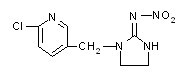
| Structural Formula |
|
| Melting point |
143.8 degrees C (crystal form 1) 136.4 degrees C (crystal form 2) |
| Solubility |
0.51g/l in water, Miscible in n -hexane, dichloromethane, 2-propanol, toluene. |
| Vapor pressure |
200 mPa at 20 ºC |
| Formulations |
|
95%TC, 20%SL, 25%WP.
|
| Application |
|
Imidacloprid is a systemic, chloro-nicotinyl insecticide with soil, seed and foliar uses for the control of sucking insects including rice hoppers, aphids, thrips, whiteflies, termites, turf insects, soil insects and some beetles. It is most commonly used on rice, cereal, maize, potatoes, vegetables, sugar beets, fruit, cotton, hops and turf, and is especially systemic when used as a seed or soil treatment. The chemical works by interfering with the transmission of stimuli in the insect nervous system. Specifically, it causes a blockage in a type of neuronal pathway (nicotinergic) that is more abundant in insects than in warm-blooded animals (making the chemical selectively more toxic to insects than warm-blooded animals). This blockage leads to the accumulation of acetylcholine, an important neurotransmitter, resulting in the insect's paralysis, and eventually death. It is effective on contact and via stomach action. |